
Zalmai Nishat
18 March 2025
من خراسانم بزرگم که سه نیمم کردند
باد نوروز در آمیخت خراسانها را
روحالامین امینی
I am from the Greater Khurasan, chopped into three
The wind of Nowruz blows through all Khurasans.
Rohulamin Amini
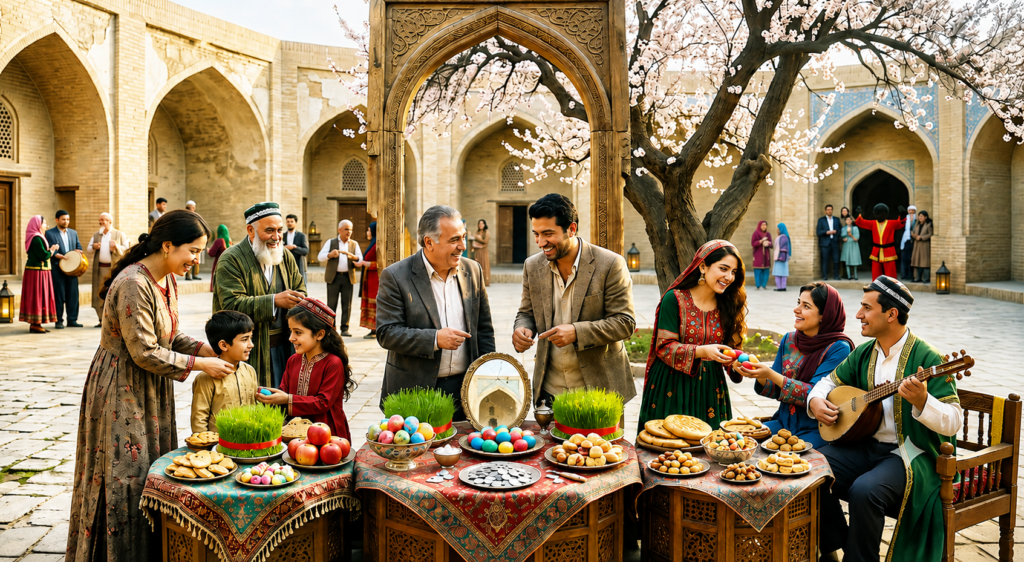
On 21 March 2025, the world will celebrate Nowruz, the Persian New Year—the first day of spring, also aptly known as Jashn-e Dehgan (the Festival of the Farmer). Nowruz literally means “new day,” marking the arrival of spring when the length of day and night becomes equal. This celestial event brings about a transformation in the atmosphere, allowing trees and flowers to bloom and nature to revive. It is this renewal of life that gives the occasion its name, the Festival of the Farmer. Metaphorically, Nowruz symbolises a fresh beginning, a reminder that after the long, cold, and harsh winter, spring always arrives. As a beautiful Persian saying goes, “After every darkness, there is light,” akin to the English expression, “There is light at the end of the tunnel.” It is a timeless message of resilience and hope.
Origins of Nowruz
Over 3,000 years ago, the Zoroastrians, originating from Balkh—an area once known as Bactria, now located in northern Afghanistan and parts of Tajikistan—began celebrating Nowruz. Their calendar was based on the movement of the sun, ensuring that the new year began with the arrival of spring. In the 11th century, the renowned Persian poet and mathematician Omar Khayyam, who spent his early life in Balkh, further refined this calendar. His version was so precise that it surpasses both the Julian and Gregorian systems. For more than three millennia, those with roots in Balkh, Persia, and the lands that witnessed the rise and fall of empires have preserved the tradition of Nowruz. Over these 3,000 years, the culture and civilisation of Persian in Balkh spread across the Indian Subcontinent, Central Asia, the Caucasus, West Asia, and the Balkans.
As mentioned earlier, the timing of Nowruz is not arbitrary or incidental. It is rooted in scientific precision and a deep understanding of nature and the universe. Nowruz coincides with the vernal equinox, the astronomical event when the sun crosses the celestial equator, resulting in equal lengths of day and night. This shift is palpable, affecting everything—plants, animals, and humans alike. Nowruz, therefore, is an inheritance from a world that once followed the rhythms of the earth, rather than arbitrary dates dictated by religious or political authorities.
A Shared Heritage Connecting the “Persianate World”
Nowruz is a shared heritage stretching from the Indian Subcontinent to Anatolia and the Balkans. It is celebrated in Pakistan, India (particularly among the Parsis), Afghanistan, Tajikistan, Uzbekistan, Kazakhstan, Kyrgyzstan, Turkmenistan, Azerbaijan, Georgia, Turkey, Albania, Bosnia, and even parts of Iraq, Syria (especially among the Kurds), Russia, and China. Historically, Persian was the language of courts, science, philosophy, and trade in these regions, connecting them into a vast cultural and intellectual network. This shared linguistic and cultural heritage created what scholars have called the “Balkan-to-Bengal complex,” a term that reflects the interconnectedness of these regions under the broader Persian cultural sphere—often referred to as the “Persianate world.” This concept builds on the seminal work of world historian Marshall Hodgson in his two-volume The Venture of Islam (1963). Let me briefly introduce Hodgson’s conceptual framework, including terms like “Islamdom,” “Islamicate,” and “Persianate world.”
Hodgson introduced the term “Islamdom” to describe the societal and civilisational aspects of Islam, distinct from the religion itself. While “Islam” refers to the faith, practices, and beliefs of Muslims, “Islamdom” encompasses the broader political, cultural, and economic structures that developed in regions where Islam played a dominant role. This distinction allowed Hodgson to coin the term “Persianate world,” which highlights areas deeply influenced by Persian culture, language, and governance, even as they adopted Islamic faith and practices. Hodgson’s framework separates faith from culture, recognising that they are not the same. According to him, the Persian cultural sphere extended far beyond Persia (modern-day Iran) to regions such as West Asia, Central Asia, Afghanistan, and the Indian Subcontinent. The Persianate world represented a blend of pre-Islamic Persian traditions with Islamic elements, shaping fields like art, literature, administration, philosophy, and tasawwuf (Islamic mysticism), as well as fostering values like tolerance.
Hodgson also contrasted two other terms: “Islamicate” and “Persianate.” By “Islamicate,” he referred to the broader influence of Islamic civilisation, encompassing diverse cultural contributions from Arabs, Turks, and others. Meanwhile, “Persianate” focuses specifically on the legacy of Persian culture within the Islamic world. Hodgson’s framework allows us to appreciate the rich and diverse tapestry of Islamic history, moving beyond a purely religious lens.
Following Hodgson, since the early 1990s, numerous scholars have explored different dimensions of the Persianate world and its civilisational influences across the aforementioned geographies. For example, Professor Nile Green’s edited volume, The Persianate World: The Frontiers of a Eurasian Lingua Franca, bringing together a number of scholars, maps the cultural terrain from the Balkans to Bengal, highlighting the influence of Persian culture on diverse societies. Similarly, Professor Richard Eaton’s book, India in the Persianate Age: 1000–1765 (2020), examines the profound impact of Persianate civilisation in India.
In short, while Persian language historically served as a connecting thread among diverse communities from the Balkans to Bengal, its cultural and civilisational legacy remains significant. The widespread celebration of Nowruz across this vast region offers hope for renewed connectivity and integration based on shared heritage.
In Lieu of Conclusion: Women and Girls in Afghanistan
At the outset, it was explained that Nowruz not only symbolises the revival of nature, rooted in ancient understandings of the universe, but also metaphorically represents the idea that even the darkest phases of life can be overcome through perseverance and the struggle for positive change. It is also about the timeless message of resilience and hope. Today, despite the Taliban’s return to power in Afghanistan, nearly four years ago, the women and girls of the country have not given up. They continue to fight for a life of dignity, freedom, equality, and fraternity—one that recognises diversity and pluralism. Their brothers, too, are fighting for the same cause in the valleys and mountains of the country. Organisations like Arman in France and the Mosaic Foundation in the UK are dedicated to amplifying these voices. They resonate the voices of those fighting for a dignified life, striving to restore timeless values such as freedom, equality, and justice. Both organisations believe in unity through diversity and equality as the foundation for sustainable peace and a brighter future. Our shared heritage, embodied in occasions like Nowruz, gives us hope for unity in diversity and purpose to join forces with each other for a positive impact.